

The investigation of how fires develop and spread, which materials are particularly at risk of fire, within which time successful firefighting can be expected and similar questions in this context are increasingly the subject of scientific investigations. In order to test and demonstrate the suitability of different fire detectors for different types of fires, a fire test room was set up in our new building. Thanks to its practical layout and the installation of suitable extinguishing agents, we can now safely experiment with fires up to a certain size in this room.
In Europe, the Technical University of Aachen in Germany is the main centre for this research. In addition to fire insurance companies and fire prevention services, this research is naturally of interest primarily to manufacturers of fire alarm systems. Securiton has adopted the findings from these state-of-the-art investigations for its range of fire detectors. Ultimately, there is no such thing as the best fire detector – it is all about having the right detector at the right place. In a slowly spreading smouldering fire, for example, a smoke detector will be superior to a thermal detector, as the increase in heat – at least in the initial phase – is only small yet the smoke development is already considerable. An alcohol fire, on the other hand, is practically smoke-free but generates significant increases in temperature. In this case, only a thermal detector is worth considering.
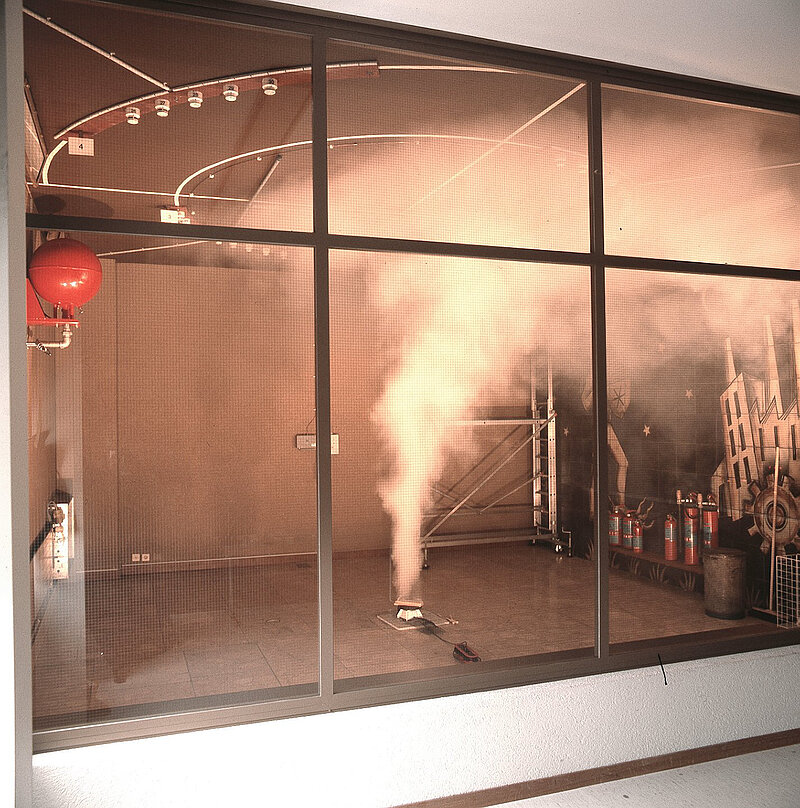
In order to test and demonstrate the suitability of different fire detectors for different types of fires, a fire test room was set up in our new building. Thanks to its practical layout and the installation of suitable extinguishing agents, we can now safely experiment with fires up to a certain size in this room. Two Pyrotector smoke detectors and differential detectors with different sensitivity are mounted at six points in the test room, which is 6 metres long and about 3 metres high. All detectors are individually connected to a recording device, which can be used to read which detectors have triggered an alarm and how much time (to the second) has elapsed between the ignition of the fire and the alarm release. At the same time, the development of fire characteristics can be continuously recorded for each measuring point (e.g. temperature and smoke concentration).
In order to protect staff and other spectators from smoke and fire gases, all recording and operating devices are located outside the actual test room, where the development of the fire can be observed through a large shatterproof and heat-resistant window. An exceptionally powerful ventilation system is installed so that normal conditions can be quickly restored after a test. In practice, beams often hinder the uniform spread of heat and smoke on a ceiling, which naturally also affects the function of the fire detectors. Such conditions can also be simulated in the test room by installing 50 cm high dummies to represent the beams.
It was recognised early on that experiments carried out by different institutions and firms gain considerably in value when they can be compared with one another. If this is to happen, however, the conditions under which the experiments are carried out must be the same. For this reason, the Technical University of Aachen has drawn up precise standards for tests with fire detectors, which primarily relate to the type of fire. For example, a wood fire test is carried out with one kilogram of wood pieces that are 25 cm long, 2 cm wide and 1 cm thick. In the smouldering fire test, 250 g of these pieces are heated by a 1,800 W plate. A file fire is demonstrated with three folders containing 5.5 kg of paper, ignited by a 1.2 kW heater at a distance of 8 cm. For an alcohol fire, 200 cm of alcohol is ignited in a bowl measuring 20x20x5 cm. Other standards also exist for various other fires, such as cable fires, waste bin fires, cotton fires, petrol fires, etc.
To conclude, we would like to underline that the tests are only justified if the detectors are set exactly as they have to be in reality at the customer. It is, of course, pointless to carry out demonstrations with such sensitive detectors as the rate of false alarms would mean they are not considered. While the – sometimes very impressive – detector response times cannot be overlooked, the fact is that a direct alarm transmission to the fire brigade is more important than the seconds that could be saved using them. After all, it is not the fastest possible alarm transmission that is decisive in extinguishing a fire, but rather the rapid arrival of the fire brigade at the scene!